Monday, September 29, 2014

Memes for Good, not Evil

The lesson for this 8th grade Topics in Media and Technology class was modified from Dave Baroody's Medieval Memes lesson, and the KQED How to Make a Meme video.

I started class by showing students a meme, and I asked them to tell me how memes work. After they had done that, I explained to them that the walls in my room were bare, and I wanted to make my room the most welcoming room ever. But, I told them, I didn't just mean, "Welcome to tech class." I meant, "You are welcome in this room, and it is a safe space."
They didn't quite get it at first (the first class gave me a lot of memes that had a message of, "Welcome to tech class. Tech class is fun." After the first group of students, I had each class generate a list of identity markers for which people are sometimes excluded, mocked, or ostracized. The lists tended to include socio-economic status, race, ethnicity, religion, gender, sexuality, interests. After making the lists, I explained to the students that I wanted the message of welcome to say, regardless of identity marker, you are safe here. 

Then, we talked about text/subtext, the relationship of the words to the picture, the concept of setup on the top line and payoff on the bottom line, and most importantly:
Remember that memes are meant to be funny . . . Annnnnnd these memes also need to be welcoming and kind . . . Annnnnnnd that's the challenge.
We watched the KQED video as a class, and then students worked in groups of 1, 2, or 3 to make memes.

I had students save their memes as jpgs to a shared Google folder as they completed them, and I projected the folder on the board, so they could see other people's memes as they were created. In each class, the memes started off pretty not-so-great, and then got better and better as students worked on them and saw each others' creations. It was an active learning process for students to be thinking about how welcoming or not welcoming a message might be and how the person in the image was being positioned.

At the end of class, we took a few minutes to debrief as we looked at each others' memes. Almost every student commented on the fact that it was really hard to be funny and kind at the same time. We talked about how this was hard work, and about how we often don't consider how people are being positioned when we make and share things online.

Annnd phew. Because that's why were were doing the lesson.

One last note: I put this caveat (taken from David Baroody) on the moodle site and shared it verbally as well:
Why would I give you an assignment where I knew you might run into material that may be deemed inappropriate? It is NOT because I am trying to corrupt you!
As a citizen of the digital world, you need to realize that the internet is an ENORMOUS place, and that inappropriate content, information, and individuals are out there.
More important than just realizing it's there, though, you need to understand how to protect yourself and others from images, links, and other content in which you (or others) do not wish you to engage. As an educator who employs an increasingly large amount of digital technology, I would rather have an open discussion about this with you, your peers, and your parents than ignore the issue.
If you are interested in some of the theory behind digital citizenship, please look over the Nine Elements of Digital Citizenship here.


Tuesday, September 23, 2014

How Do We Really Get to Know Our Students? iMovie!

Because all of Ms. Bo's students are new to the middle school, Ms. Bo knows that helping them to feel known is key to a successful start. So, the first unit of Ms. Bo's history class investigates primary sources. The class talks about the ways their identities impact their understanding of history, and they talk about the fact that they are the best sources for information about themselves.

In the past, Ms. Bo has had each student create a collage that demonstrates investigation into the source that is their self. Then, the students write an 8-10 sentence paragraph about the collage and the interpretation of their self.

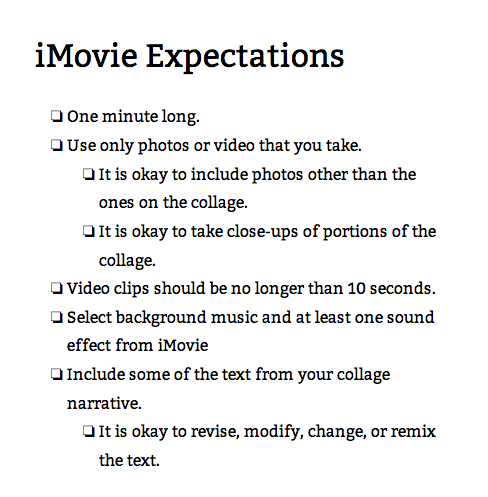
This year, Ms. Bo decided to incorporate iMovie as a digital collage, so I had the chance to collaborate with her. To keep the project manageable, we came up with this list of criteria that we shared with the students as a Google Doc:
iMovie Expectations
We asked for one minute so it was easy to share, and we had students stick to pictures they took and stock music and sound because we didn't want to compound what they needed to know about citation for the project. Since each student had a computer with iMovie already, we didn't have to worry about access, but Ms. Bo made sure to schedule plenty of in-class time to work so she could identify potential hiccups students had with using the program.

When Ms. Bo introduced the project, she first asked the students what you need to make a movie. The students shouted out ideas like a script, actors, scenery, music. Ms. Bo pointed out that they had a script: the paragraph they had already completed, and they had an actor: themselves, and they had scenery: the music. Then, I did a mini-lesson on how to use iMovie, and we let them work. We posted the instructions to Moodle as well:
The students had a lot of questions about whose picture they could use - they REALLY wanted to use photos from the internet. They also REALLY wanted to use copyrighted music. We stuck with no.

When the students went home to work on the projects, they sent Ms. Bo a lot of alarmed emails about the project, which surprised us because in class, they had seemed so on top of it. The next day, in class, it turned out that the students completely had the hang of using iMovie. We weren't entirely sure why they panicked . . . maybe because it was new to them and they were still adjusting to the middle school?

To complete the project, Ms. Bo had each student show their movie, one after another. She used the expectations as her assessment rubric, and graded them as the students showed the movies. Sitting in the classroom, listening to the students say, "Awwww!" and, "I love horses, too!" was amazing. All the students' personalities piled up on top of each other, and you could feel the group coming together as a class that cared about their classmates because each one was known. 

I thought about including some samples of the videos, but then I thought about how personal each one was. Even though the students gave me permission to share their work, I didn't want to publish videos with that much personal information. That said, here's a photo of students watching the videos during class:

Wednesday, March 5, 2014

Reading the Forum

The only picture of me speaking at the
Forum because the students
were speaking the rest of the time.
Last week I had the chance to present on Practitioner Day at the Ethnography Forum. My presentation was Literacy in an Out of School Space: What Counts Here? Well, I say MY presentation, but really, I was just the person who wrote the proposal. In reality, the four students and park ranger with whom I presented were the bringers of knowledge, and I was the person who clicked the button when the slides needed to advance.

And we made people cry.

Not the bad kind of crying, where people are sad. The good kind of crying, where people are so amazed by the insights of the youth that the experience is cathartic for the participants. Behar (1996) writes about this sort of ethnography in The Vulnerable Observer: Anthropology that Breaks Your Heart, saying, "I think what we are seeing are efforts to map an intermediate space we can't quite define yet, a borderland between passion and intellect, analysis and subjectivity, ethnography and autobiography, art and life" (p. 174). The students presented their ideas in a traditional way, but as students, they're not the ones whose voices are typically heard in educational research. That was my goal with this presentation - not just to share my interpretations of their experiences but instead to have them share.

The students were looking at their ways of understanding audience in relationship to blog posts that were responded to by adults from around the country - some who agreed with them, and some who didn't. Their take-aways for teachers were:
  1. Place-based learning is memorable. (This because none of the four will ever forget that Robert Hemings, Thomas Jefferson's slave, was absent from a museum exhibit, and that led to deep discussions about what it means to write the Declaration of Independence when a slave is bringing you your slippers)
  2. Big audiences are good for revision. (This because all four students felt that the responses from people from around the country led them to consider deeply what they'd written and what they meant, and if the audiences' responses indicated that those two matched)
  3. Teachers have to be very aware of what it means to put student work out to a wide audience. (This because, as one of the students said, "It's scary. Really scary." Also because, as another student said, "When you know your work is going to be read by a lot of people, there's a lot that you won't say. A lot of topics that you're not willing to go into."
The more time I spend thinking about research, the more I realize that I want to keep positioning myself in this interpretive mode of education research (Erickson, 1986). As Behar (1996) asks, "Can we speak in a way that matters, in a way that will drive a wedge into the thick mud of business as usual" (p. 166)? As I keep looking at youths' writing with them, can I help to make visible the writing practices that they find useful and inspiring? If I do that, can I help to speak back to writing practices that are imposed on youth by external sources? Practices that look more like this.

I was so incredibly impressed by the students' presentation, by their intelligence, and by their generosity in sharing their time for the Forum.

References:

Behar, R. (1996). The vulnerable observer: Anthropology that breaks your heart. Boston, MA: Beacon.

Erickson, F. (1986). Qualitative methods in research on teaching. In M.C. Wittrock (Ed.), Handbook of research on teaching (3rd ed.). New York, NY: MacMillan.

Tuesday, February 25, 2014

Digital Literacies and 911

*This post is about something that was pretty scary, and the ending isn't necessarily happy. I'm not graphic about it, but I wanted to give people a heads up.

Last night, I was leaving a meeting, looking at the train schedules on my phone. One of my friends shouted, "Bethany! Call 911." I heard a gasp and looked up. A woman had fallen on the ground, and she was having a seizure.

I called 911. We were on a busy street, and it was hard to hear the operator. Was the victim conscious? No. Was the victim breathing? Yes. Was the victim garble-garble? What? Was the victim garble-garble? I can't hear you! Keep the victim garble-garble. Don't garble-garble. I CAN'T HEAR YOU!

The operator hung up.

I stared at my phone. The operator had hung up. Brain didn't compute. Hurt person on ground. Help person. Cover person. Comfort person. Where ambulance?

I looked up. There was a huge crowd of people, and every single one of them was calling 911.

The ambulance came a few moments later, and the paramedics took over.

How does this incident speak to digital literacies? There's an article I really like, Vasudevan (2010), that considers the affordances of portable technologies like  MP3 players, handheld video game players, and cell phones in relationship to literacy. Vasudevan writes, ". . .the value of these technologies is underrepresented in studies focusing on the intersections of literacies and technologies in the lives of youth who . . . are perceived to be on the margins of educational discourses" (p. 67).

For me, in an emergency, instinct takes over. I called 911 because someone told me to, not because I was actively engaging in digital literacy. Looking at the way the group operated, though, I see connections between digital literacies and the emergency.

Apparently, in Philly, there's a belief that ambulances take a long time, and sometimes they don't come. I can't say if that's true or not. What I know is, the people in the group believed it, and I heard a lot of comments like: "They come when a lot of people call," "The call dropped? Call them back," and, "Do you have a phone? You call 911, too." What I saw from that group of people in relation to portable technologies was an accessing of a shared belief (that 911 calls are more effective when multiple), a feeling of agency (that their phone calls would affect the speed of the response), human contact (working together to execute a plan), and digital literacy (in the sense that responders were using technologies to communicate rather than in the sense that they were using technologies to communicate through symbols like writing . . . that's an entire paper, though, so I'm not going to go into it).

I know that there are both problems and affordances related to cell phones, but last night I was really glad that we all had phones.

I hope that the woman who had the seizure is okay.

(PS I have a feeling that multiple calls to 911 could clog up the system, and I'm sure that some people will question that the group acted together to make multiple calls. I want to emphasize that the woman was in critical condition, the first call to 911 resulted in a hang-up, and an ambulance - with lights on - drove past while we were trying to get help)

Reference:
Vasudevan, L. (2010). Education remix: New media, literacies, and the emerging digital geographies. Digital Culture & Education. 2:1, 62-82

Thursday, February 13, 2014

Snow Day Science

When I first started teaching, I taught at a preschool founded on Reggio Emilia theories. My mentor had an amazing way of considering children's interests and merging them with science and art . . . I'm pretty sure that this came from her. 

Today, my son, Arden, had a snow day. We spent the morning sledding, but in the afternoon, the snow had turned to rain. It was too rainy to go outside, and he still wanted to play in the snow. Taking my lead from Reggio Emilia theories, I considered his interests - touching snow, scooping, and measuring - and we did this experiment.

First, I went outside and grabbed a bowlful of snow:
Arden measured and scooped the snow into bags:
I held the bags open while he put colors into them. In this one, he mixed blue and yellow.
I asked, "What color do you think blue and yellow will make?"
He said, "Brown."
I said, "Let's see if your prediction is right."
We sealed up the bag, and he mashed up the snow. When he saw that the snow was green, he shouted, "Yellow and blue make green!"
I was pretty psyched.
We repeated the experiment with yellow and red and then red and blue. When we were done, we laid out all the bags in rainbow order.

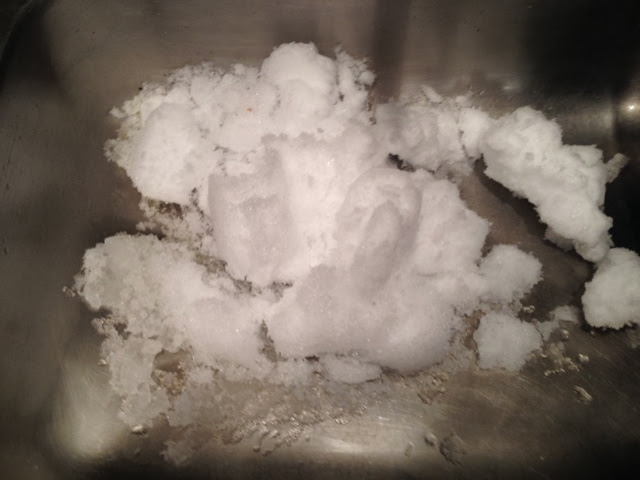
After making all our colored bags of snow, we put the extra snow in the sink.
I asked, "What's going to happen to the snow?"
He said, "It water."
I asked, "So snow is water?"
"Yes," he said. "It cold."
I said, "That's called a phase change. Water can be liquid, solid, or vapor, like steam."
He said, "Phase change?"
I don't think he really got the idea of liquid, solid, or vapor, but he understood that snow was cold water, so I left it at that for today.
Arden especially enjoyed flinging the snow under the faucet.

The connection between Reggio Emilia theories - following student interests to develop a deep understanding of concepts - relates to digital media ideas like the Maker Movement, Connected Learning, and Participatory Cultures (Jenkins et al., 2006) in that playing and exploring are considered to be valuable parts of the learning process. This often makes learning incredibly messy (for example, explaining to Arden that the food coloring wasn't going to come off his hands right away didn't go so well, he was only interested in the project while he was measuring and smashing, and the only color he was truly interested in making was brown, even though I was convinced that making a full rainbow was VERY important), but when he  shouted, "Blue and yellow make green!" and explained that snow was water, he was both messing around and learning key scientific ideas.

Also, it was a heck of a lot more fun than staring out the window and wishing we could go sledding some more.

References
Jenkins, H., Clinton, K., Purushotma, R., Robison, A. J., & Weigel, M. (2006). Confronting the challenge of participatory culture: Media education for the 21st Century. Retrieved from The John T. and Catherine T. MacArthur Foundation: http://digitallearning.macfound.org/atf/cf/%7B7E45C7E0-A3E0-4B89-AC9C-E807E1B0AE4E%7D/JENKINS_WHITE_PAPER.PDF.

Monday, February 10, 2014

Hidden History, Moonstone Arts, and Why I Love Writing in Groups

Saturday was the Charlotte Forten Writing Workshop (put on by the Philadelphia Writing Project, NMAJH, and Moonstone Arts).

When I was young, I thought that the reason there weren't any women in history books (other than in special block sections proclaiming that they were, in fact, important) was because women really hadn't done anything important.

That is not a lie. That was hegemony in practice*.

That might be why I love Moonstone Arts's Hidden History series. It's an opportunity to learn about people who don't make it into the history books or who only get a special block section.

The workshop on Saturday brought together students, teachers, parents, grandparents, actors, and scholars. Elijah Pringle, Jonathan Steadman, and Bethlehem presented Charlotte Forten's journal entries by having Jonathan act as interviewer and Bethlehem play the role of Charlotte Forten reading from her journal. At every 'commercial break,' Elijah gave students a writing prompt that related to the journal entry. At the end of each break, we shared what we wrote.

Charlotte Forten was an abolitionist, educator, member of Port Royal Experiment, Philadelphian, and writer. Her journals (where she casually mentions meeting Colonel Robert Shaw) provide a first-hand account of living before, during, and after the civil war.

This photo is of Bethlehem playing the role of Charlotte Forten as she read Forten's 6/2/1854 response to the decision against Anthony Burns:
And if resistance is offered to this outrage, these soldiers are to shoot down American citizens without mercy; and this by the express orders of a government which proudly boasts of being the freese in the world; this on the very soil where the Revolution of 1776 began; in sight of the battle-field, where thousands of brave men fought and died in opposing British Tyranny, which was nothing compared with the American oppression to-day. I can write no more. A cloud seems hanging over me, over all our persecuted race, which nothing can dispel.
The writing prompt we used with this was, "What do you witness in the world around you? How do you feel about it? Write a journal entry about something you have seen that stirred your emotions."

Throughout the workshop, the writing ranged from poignant to silly, and each time someone shared her writing, I was reminded of why I love writing in groups: because everyone can be inspired by the same passage, and there's something amazing about the differences in people's responses.

At the end of the workshop, everyone got free admission to the museum. That was when I saw this book. I cannot tell you how happy I am that there's a book called My First Kafka. Sigh. Love post-modernism when it does things like this.


Although this post is way, way too long, I'm going to put in links to two videos made by participants in the NMAJH Story Corps booth. You have to link through the captions because Blogger and Story Corps didn't want to format nicely together. 
Take Me Out to the Ballgame
What Does Freedom Mean to You?
At the end of the day: found this on a table tent. Thank YOU, Emilie and Pam, for participating!

If you're interested in getting a copy of the booklet that we gave to participants (because it's awesome), email larrymoonstoneartscenter.org to find out more. 


*Dave Baroody, I am aware that I have to put a quarter into the grad school jar now.

Wednesday, September 18, 2013

Update to My Book Map

So, my mom, who was mentioned in My Book Map, pointed out a few things that she wanted me to clarify about my reading history.

1. She never censored books. 

In some ways, this was fun. For example, in 1984, I was 7, and I read 1984 because I thought you were supposed to. I didn't understand a word of it, but I read it.

In other ways, this was terrifying. Like when I found The Exorcist on the bookshelf and couldn't sleep for a week. Note: if you like to sleep, do NOT read The Exorcist. Especially if you're Catholic, and you then ask your uncle, who is a priest, about exorcisms, and he says, "The church doesn't like to talk about it," which, when you're a teenager (or an adult for that matter) means that your imagination is now free to tell your brain that since he didn't deny it, then it's totally real.

And now I'm not going to be able to sleep again tonight.

2. We borrowed books all the time.

I didn't have time in the movie to write about the 100,000,000 trips that we took to the library or taking part in library summer reading programs or the bookmobile that came to my school or the other ways that we borrowed books. My mom insists that means I didn't steal books; rather, I borrowed them for a really long time. 

There's some books on my bookshelf that tell a different story.