Tuesday, February 25, 2014

Digital Literacies and 911

*This post is about something that was pretty scary, and the ending isn't necessarily happy. I'm not graphic about it, but I wanted to give people a heads up.

Last night, I was leaving a meeting, looking at the train schedules on my phone. One of my friends shouted, "Bethany! Call 911." I heard a gasp and looked up. A woman had fallen on the ground, and she was having a seizure.

I called 911. We were on a busy street, and it was hard to hear the operator. Was the victim conscious? No. Was the victim breathing? Yes. Was the victim garble-garble? What? Was the victim garble-garble? I can't hear you! Keep the victim garble-garble. Don't garble-garble. I CAN'T HEAR YOU!

The operator hung up.

I stared at my phone. The operator had hung up. Brain didn't compute. Hurt person on ground. Help person. Cover person. Comfort person. Where ambulance?

I looked up. There was a huge crowd of people, and every single one of them was calling 911.

The ambulance came a few moments later, and the paramedics took over.

How does this incident speak to digital literacies? There's an article I really like, Vasudevan (2010), that considers the affordances of portable technologies like  MP3 players, handheld video game players, and cell phones in relationship to literacy. Vasudevan writes, ". . .the value of these technologies is underrepresented in studies focusing on the intersections of literacies and technologies in the lives of youth who . . . are perceived to be on the margins of educational discourses" (p. 67).

For me, in an emergency, instinct takes over. I called 911 because someone told me to, not because I was actively engaging in digital literacy. Looking at the way the group operated, though, I see connections between digital literacies and the emergency.

Apparently, in Philly, there's a belief that ambulances take a long time, and sometimes they don't come. I can't say if that's true or not. What I know is, the people in the group believed it, and I heard a lot of comments like: "They come when a lot of people call," "The call dropped? Call them back," and, "Do you have a phone? You call 911, too." What I saw from that group of people in relation to portable technologies was an accessing of a shared belief (that 911 calls are more effective when multiple), a feeling of agency (that their phone calls would affect the speed of the response), human contact (working together to execute a plan), and digital literacy (in the sense that responders were using technologies to communicate rather than in the sense that they were using technologies to communicate through symbols like writing . . . that's an entire paper, though, so I'm not going to go into it).

I know that there are both problems and affordances related to cell phones, but last night I was really glad that we all had phones.

I hope that the woman who had the seizure is okay.

(PS I have a feeling that multiple calls to 911 could clog up the system, and I'm sure that some people will question that the group acted together to make multiple calls. I want to emphasize that the woman was in critical condition, the first call to 911 resulted in a hang-up, and an ambulance - with lights on - drove past while we were trying to get help)

Reference:
Vasudevan, L. (2010). Education remix: New media, literacies, and the emerging digital geographies. Digital Culture & Education. 2:1, 62-82

Thursday, February 13, 2014

Snow Day Science

When I first started teaching, I taught at a preschool founded on Reggio Emilia theories. My mentor had an amazing way of considering children's interests and merging them with science and art . . . I'm pretty sure that this came from her. 

Today, my son, Arden, had a snow day. We spent the morning sledding, but in the afternoon, the snow had turned to rain. It was too rainy to go outside, and he still wanted to play in the snow. Taking my lead from Reggio Emilia theories, I considered his interests - touching snow, scooping, and measuring - and we did this experiment.

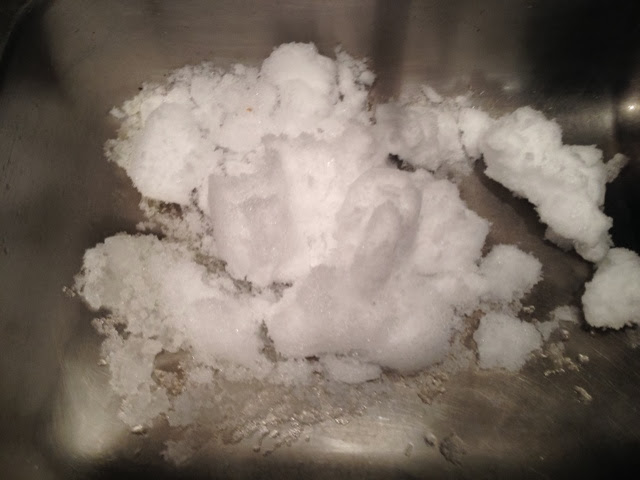
First, I went outside and grabbed a bowlful of snow:
Arden measured and scooped the snow into bags:
I held the bags open while he put colors into them. In this one, he mixed blue and yellow.
I asked, "What color do you think blue and yellow will make?"
He said, "Brown."
I said, "Let's see if your prediction is right."
We sealed up the bag, and he mashed up the snow. When he saw that the snow was green, he shouted, "Yellow and blue make green!"
I was pretty psyched.
We repeated the experiment with yellow and red and then red and blue. When we were done, we laid out all the bags in rainbow order.

After making all our colored bags of snow, we put the extra snow in the sink.
I asked, "What's going to happen to the snow?"
He said, "It water."
I asked, "So snow is water?"
"Yes," he said. "It cold."
I said, "That's called a phase change. Water can be liquid, solid, or vapor, like steam."
He said, "Phase change?"
I don't think he really got the idea of liquid, solid, or vapor, but he understood that snow was cold water, so I left it at that for today.
Arden especially enjoyed flinging the snow under the faucet.

The connection between Reggio Emilia theories - following student interests to develop a deep understanding of concepts - relates to digital media ideas like the Maker Movement, Connected Learning, and Participatory Cultures (Jenkins et al., 2006) in that playing and exploring are considered to be valuable parts of the learning process. This often makes learning incredibly messy (for example, explaining to Arden that the food coloring wasn't going to come off his hands right away didn't go so well, he was only interested in the project while he was measuring and smashing, and the only color he was truly interested in making was brown, even though I was convinced that making a full rainbow was VERY important), but when he  shouted, "Blue and yellow make green!" and explained that snow was water, he was both messing around and learning key scientific ideas.

Also, it was a heck of a lot more fun than staring out the window and wishing we could go sledding some more.

References
Jenkins, H., Clinton, K., Purushotma, R., Robison, A. J., & Weigel, M. (2006). Confronting the challenge of participatory culture: Media education for the 21st Century. Retrieved from The John T. and Catherine T. MacArthur Foundation: http://digitallearning.macfound.org/atf/cf/%7B7E45C7E0-A3E0-4B89-AC9C-E807E1B0AE4E%7D/JENKINS_WHITE_PAPER.PDF.

Monday, February 10, 2014

Hidden History, Moonstone Arts, and Why I Love Writing in Groups

Saturday was the Charlotte Forten Writing Workshop (put on by the Philadelphia Writing Project, NMAJH, and Moonstone Arts).

When I was young, I thought that the reason there weren't any women in history books (other than in special block sections proclaiming that they were, in fact, important) was because women really hadn't done anything important.

That is not a lie. That was hegemony in practice*.

That might be why I love Moonstone Arts's Hidden History series. It's an opportunity to learn about people who don't make it into the history books or who only get a special block section.

The workshop on Saturday brought together students, teachers, parents, grandparents, actors, and scholars. Elijah Pringle, Jonathan Steadman, and Bethlehem presented Charlotte Forten's journal entries by having Jonathan act as interviewer and Bethlehem play the role of Charlotte Forten reading from her journal. At every 'commercial break,' Elijah gave students a writing prompt that related to the journal entry. At the end of each break, we shared what we wrote.

Charlotte Forten was an abolitionist, educator, member of Port Royal Experiment, Philadelphian, and writer. Her journals (where she casually mentions meeting Colonel Robert Shaw) provide a first-hand account of living before, during, and after the civil war.

This photo is of Bethlehem playing the role of Charlotte Forten as she read Forten's 6/2/1854 response to the decision against Anthony Burns:
And if resistance is offered to this outrage, these soldiers are to shoot down American citizens without mercy; and this by the express orders of a government which proudly boasts of being the freese in the world; this on the very soil where the Revolution of 1776 began; in sight of the battle-field, where thousands of brave men fought and died in opposing British Tyranny, which was nothing compared with the American oppression to-day. I can write no more. A cloud seems hanging over me, over all our persecuted race, which nothing can dispel.
The writing prompt we used with this was, "What do you witness in the world around you? How do you feel about it? Write a journal entry about something you have seen that stirred your emotions."

Throughout the workshop, the writing ranged from poignant to silly, and each time someone shared her writing, I was reminded of why I love writing in groups: because everyone can be inspired by the same passage, and there's something amazing about the differences in people's responses.

At the end of the workshop, everyone got free admission to the museum. That was when I saw this book. I cannot tell you how happy I am that there's a book called My First Kafka. Sigh. Love post-modernism when it does things like this.


Although this post is way, way too long, I'm going to put in links to two videos made by participants in the NMAJH Story Corps booth. You have to link through the captions because Blogger and Story Corps didn't want to format nicely together. 
Take Me Out to the Ballgame
What Does Freedom Mean to You?
At the end of the day: found this on a table tent. Thank YOU, Emilie and Pam, for participating!

If you're interested in getting a copy of the booklet that we gave to participants (because it's awesome), email larrymoonstoneartscenter.org to find out more. 


*Dave Baroody, I am aware that I have to put a quarter into the grad school jar now.

Wednesday, September 18, 2013

Update to My Book Map

So, my mom, who was mentioned in My Book Map, pointed out a few things that she wanted me to clarify about my reading history.

1. She never censored books. 

In some ways, this was fun. For example, in 1984, I was 7, and I read 1984 because I thought you were supposed to. I didn't understand a word of it, but I read it.

In other ways, this was terrifying. Like when I found The Exorcist on the bookshelf and couldn't sleep for a week. Note: if you like to sleep, do NOT read The Exorcist. Especially if you're Catholic, and you then ask your uncle, who is a priest, about exorcisms, and he says, "The church doesn't like to talk about it," which, when you're a teenager (or an adult for that matter) means that your imagination is now free to tell your brain that since he didn't deny it, then it's totally real.

And now I'm not going to be able to sleep again tonight.

2. We borrowed books all the time.

I didn't have time in the movie to write about the 100,000,000 trips that we took to the library or taking part in library summer reading programs or the bookmobile that came to my school or the other ways that we borrowed books. My mom insists that means I didn't steal books; rather, I borrowed them for a really long time. 

There's some books on my bookshelf that tell a different story.

Sunday, September 15, 2013

My Book Map

I made this book map as an example for Educ 535 at Penn.

It's not perfect.

After I made the video, I realized that I didn't have enough time in the video to explain most of the books I chose. And, I realized that I didn't have enough time to go into pretty much all of the complicated issues around reading - how hard reading is for some students and how the types of reading in which they engage might not be valued (comic books, memes, tumblr), and how that complicates my whole, "I love books, and I want everyone else to love them, too," message.

That said, it was a lot of fun to make - Dave and I spent Friday night shooting the video with Stop Motion (which is awesome, and only costs 99 cents), and I put the rest of it together using iMovie.

In asking students to make their own book maps, I'm pointing out that I don't think my way is the right way. I used my book collection because it was a resource that I had right there. From students, I could see anything from an animoto to a glogster to a hand-drawn stop-motion map. In using the online resources, what I hope will be their biggest take-away is that, they can construct a map with paper and pen AND they can construct a map using edtech tools, too.

Tuesday, October 16, 2012

Reading Autobiography

See that? That's the new-house library-pile. That's also the ski, exercise ball, and jumper cables pile. In the library-pile, somewhere, there is an external hard drive that houses a reading autobiography that I wrote more than ten years ago to share with my students. Phooey. There's no way that I'm going to find it.

My reading life is kind of a mess right now. This is the one organized bookshelf in my whole house:
Other than this one, which is only organized because a gal's gotta eat:
This is how the other unpacked books look right now because I live with a two-year-old, and he reorganizes them on a daily basis:

Fine. If I can't find what I've already written about my reading history, I'll have to rebuild.

The first book I remember reading was The Country Bunny and the Little Gold Shoes. My older sister, my mom, and I were sitting on my sister's bed.  My sister had taken the book out of the library, and she was reading it out loud to my mom and me. She turned a page, and I started reading it out loud. Thinking I had memorized the book, my mom asked, "Oh, do you have this at preschool?"

"No," I said. "I'm reading." And then I read the rest of the book out loud to them.

My mom was so proud.

Later, my sister totally wailed on me.

I probably deserved it.

This is a modification of an image in Mo Willems's Don't Let the Pigeon Drive the Bus (This book will come up again later). The girl in the back of the bus? That's me. I have just missed my stop (which is the last stop on the line) because I am reading Shel Silverstein's A Light in the Attic, and the bus driver is trying to get me to tell him where I live. I do not know my address, so the bus driver takes me back to school. My mother is not happy. I am very proud that I was able to read an entire book of poems in JUST ONE BUS RIDE!

This is the story of my reading life: exuberant joy mixed with absolutely giant social errors. Do you know what the neighborhood kids do to the girl who missed her bus stop because she read an entire book in just one go? Do you know what they do when that girl uses giant words because she doesn't know that no one else knows them?

Never mind that those same neighborhood kids have perfectly big vocabularies and are now:
1. A lawyer.
2. A lawyer.
3. A banker. 
4. The owner of a vineyard in California.

They beat the crap out of her.

Do you know what they do when she tells them about an awesome book called Rainbow Goblins? (This, in case you didn't know, is a picture from Ul De Rico's The Rainbow Goblins. The book is freaking awesome) They stop beating the crap out of her and start playing Rainbow Goblins every day after school, using their superhero powers to destroy the goblins before the goblins can suck all the colors out of the rainbow, and therefore out of the world.

We were very powerful and very important.

My life as a writer started at the same time as my life as a reader. I never separated the two. All that acting out and playing was my first way of writing. On Saturdays, after cartoons ended (back when cartoons used to end at noon and you didn't get to watch them again until the next week), I would pretend to be Firestar from Spiderman and Friends for the rest of the day. I could never hear, read, or see a narrative without jumping into it and playing with it until it was my own.

I also wrote by hand a lot. I would add on to stories, write new stories, extend stories for a minor character that I liked a lot. I just found the box with all my writing, but my journal from third grade is somewhere in the library-pile, so I don't have an image of it. By the way, my family found that journal in the attic a few years ago and decided to read out loud at Christmas. That was awesome. I felt vindicated in knowing that my third grade self didn't trust them with her privacy either. There were a LOT of entries complaining about them.

Sometimes, when I was young, I connected with books to the point where I was inconsolable. When I read Bridge to Terebithia, I hid behind the couch and cried until my insides felt like jelly-mush. When my dad said, "Calm down, Bethany. It's only a book," that did not help.

My first job was (surprise) at a bookstore. At eight, I conned the owner into letting me dust shelves and pick dead flies out of the window in trade for books. I mostly read The Babysitters Club. These books were awesome.  They were about entrepreneurship, they were about friendship, they were about responsibility. I loved them. I am aware that these are probably not considered high-brow fiction. Have you ever noticed how we're required to put things into terms of worthy and not worthy? High-brow and guilty pleasures? What if we just enjoyed what we enjoyed without categorizing? What would that look like for students?

The thing was, I really, really loved fantasy-fiction, and in the 80s, everyone was convinced that kids loved contemporary realistic fiction. I did NOT love to read contemporary realistic fiction because, other than The Babysitters Club, it was boring. The dog always died. I loved to read fantasy, and the only books I knew that were fantasy were The Lion, the Witch, and the Wardrobe. I loved these books. I took them out of the library every time we went (which was every weekend or more . . . my mom was a big library fan.) We didn't have much money, so my mom didn't buy books unless we really, really loved them. BUT, my mom worked at the same bookstore where I worked (I probably didn't con the owner so much as just show up at work with my mother). For my eleventh birthday, I asked my mom for a really nice set of Narnia books. These books are not still packed in the basement.

They were the most beautiful books I had ever owned. After I opened them, when I started reading them for the first time (I've read them at least twenty times each) I looked at the flap on the inside, and I realized that each book cost $12.95. Times seven. $90.65. We couldn't afford that. I tried to get my mother to return the books to the store. She wouldn't. I will never, ever get rid of these books. I will never, ever let anything bad happen to them. These books say, 'You have value as a reader, and we love you for that.'

High school happened, and I read every book they told me to. I also stole a lot of books because I have a really bad habit of not returning books that I've borrowed. Some day, I will have to donate a LOT of books to the Concord, NH School District. Here is a list of books I have stolen: A Wrinkle in TimeOne Flew Over the Cuckoo's NestThe Mists of AvalonThe Red TentPet SemetaryThe OmenThe HobbitThe Collected Works of Nikolai Gogol, The Yellow Wallpaper.

(A quick aside, my writing and reading life happened at the same time that my mother's reading life happened . .  not to tell her story for her too much, but when I was in middle school, she started working at the library. By the time I finished high school, she had graduated from college. By the time I finished college, she was an adjunct prof. and school librarian. In 2011, she was named NH School Librarian of the Year.)

College happened, and I read every book they told me to and I wrote a lot. In college, I kept trying to write and read children's stories. They told me these sorts of things about that:
"Juvenile"
"An experiment that failed."
"This is great, but you're not allowed to write another paper like this"

Teaching happened. At first, I thought my students needed to all read the same book at the same time and understand the important metaphors and similes. They hated that as much as I had. I thought about that. In the second month of my first year of teaching, I stood in line with my students to get our copies of Harry Potter signed. Three hours of standing in the rain to meet J.K. Rowling. Our collective love of a book morphed into a collective love of books.

I started using Reader's Workshop. We all read what we wanted to read, and we had a great time.

My master's degree happened. It was in Writing for Children and Young Adults at Vermont College of Fine Arts. I learned a LOT. Including when and why what I was writing for children actually WAS juvenile or an experiment that failed. And when, maybe, my writing was okay, too.  We spent a lot of time talking about the validity of children's voices and what they care about.

That's when I really started to understand that there's way more than one way to read or write a book. The important part wasn't what my students were reading. It was how my students were reading. I started trying to find ways for youth to interact with books that mimicked the playing that I did when I was younger, and using technology felt like the natural way to do that.

To make our comic, we read Atalanta and the Three Golden Apples. Then, we made a storyboard, adapting as we went. We divided up the different sections of the storyboard, and used the ComicBook! app to 'write' the story.

We jumped into picture books that we loved and played around in there (Remember Don't Let the Pigeon Drive the Bus? Here it is again.) First, we read the book, then we talked about how to set up the book so everyone had a fair part. Frank, the adult, became the bus driver for two reasons: first, the kids couldn't decide which kid should be the bus driver; second, Frank looked like the bus driver in the pictures. We all took turns shooting the scenes, and then I did some work on it after the kids were done.  We featured this movie at our annual Talent Extravaganza to raise money for King Street Center.


The King Street Kids also taught me to NEVER tell a reading group that I hate the book they have to read. This summer reading group had to read Phineas T. MacGuire . . . Erupts! for school. I didn't like the book at all. I said nothing. The group loved the book so much that, when it came time to do their final project, which only had to be mixing baking soda and vinegar together, they decided to make a papier-mache volcano, paint it, and film the experiment. They found joy in the book that I didn't even know was there.

When some kids at King Street told me that they wanted to do a news report, we took that as another chance to be readers and writers. For each news report, we talked about what was going on at King Street and what people cared about. Thinking about audience was really important to the kids. Then, we split up into reporting teams, and they each wrote down three questions. The kids did the filming and the editing of the stories. I added in the subtitles with their help.

The reason readers have kids is so someone will sit in your lap and read the same book over . . . and over . . . and over . . . and over. This is my son, Arden, on the left, and Dave on the right.


Dave and I co-opt Arden's interest in books to help our students see the impact of literary terms. We shot this video last year to demonstrate 'dramatic irony' for Dave's 8th-grade picture book unit. Arden makes me read I Want My Hat Back every single night. I just read it to him fifteen minutes ago. Dramatic irony rocks.

And finally, these are the books on my nightstand. Picture book, memoir, middle grade fantasy, primary source on picture books, YA graphic novel, childrearing book, memoir, and academic non-fiction.
All the seemingly disparate elements of my reading life come together in this: for me, it's about joy. It's not about the specific texts involved, although that adds to the joy. Rather, it's about the community of engaging as a reader. That's the really powerful thing for me: the community of reading and writing. I might love the act of reading and the act of writing, but when those two things build community - be it through acting out a story with the neighborhood kids, shouting at the bunny with my son, or turning a Greek myth into a comic book - that sense of community is where the joy of reading lives, and it's where the importance of reading lies.

PS This morning, while I was trying to find my shoes, I found the external hard drive in the shoe box.